Lenovo Pocket Yoga Recently, the Internet has created photo Lenovo Pocket Yoga. It turns out that netbuk resembling Sony VAIO P, is only a concept two years ago.


As a cyclist myself I couldn’t be more happier to see this concept become reality. The video after the jump features LightLane, a bicycle light concept which aimed to increase safety of cyclists by using “super-bright red LEDs” along with two highly visible diode-pumped solid state green lasers to project a path which appears as a bike lane.


If you asked me, I can see the LightLane becoming one of the bestselling bike gadgets to come, that is if they don’t decide to overprice it too much!
This new vehicle known as the Sea Quad allows lazy surfers to surf on the beach as well as on the sea without ever needing to get up (or fall off). This is certainly no ordinary surf board. The Sea Quad is sail powered which means it does rely on wind power, the sail is connected to a steering bar allowing you to glide through winds at whatever speed it allows.

The so-called fourth-generation (4G) wireless service, is the first execution of a partnership between Comcast, Clearwire Corp. and other companies that use the emerging WiMax high-speed mobile technology.
The new service, called "Comcast High-Speed 2go," is expected to deliver data to laptops, netbooks and other devices over a wireless network at faster speeds than has been commonly available to date.
Comcast said it will offer download speeds of up to 4 megabits per second. Existing 3G wireless networks typically offer download speeds between 1 and 1.5 megabits a second.
Cablevision Systems Corp offers mobile Internet service via Wi-Fi, a short range service typically limited to a home, restaurant or "hotspot." The operator is providing Wi-Fi service to its digital subscribers throughout its market in the New York metropolitan area.
Comcast High-Speed 2go launches officially in Portland, Ore., on Tuesday and is expected to expand to Atlanta, Chicago and Philadelphia before the end of the year, Comcast said.
A Metro version of the data card, which is typically installed into a laptop to allow wireless Internet access, will cost $49.99 a month when bundled with home Internet service. The Metro version will only work within the 4G metropolitan coverage area.
A nationwide version for $69.99 a month will allow subscribers to access the Internet via Sprint Nextel Corp's 3G network where the 4G network is not available.
WiMax is expected to blanket entire cities with Web access for mobile devices at speeds up to five times faster than traditional wireless networks, but the technology is still unproven.
After previous stumbles, such as a collapsed partnership with Sprint, cable companies are hoping that Clearwire, founded by wireless pioneer Craig McCaw, will help them resolve their long-running wireless conundrum.
The cable industry is also trying to figure out ways to make more video available beyond traditional TV sets.
Last week, Comcast and Time Warner Inc. said they started testing ways to allow people to watch more TV shows over the Web, while making sure they keep paying for their traditional cable or satellite TV services.
Comcast will likely try to market the new wireless service as a way for subscribers to watch their favorite shows wherever they are in the United States.
 San Francisco - Hoping to dispel fears about the vulnerability of Windows to viruses and other malware, Microsoft on Tuesday released a trial version of a new free security package called Microsoft Security Essentials.
The software is designed to replace the Windows Defender tool that Microsoft released in 2007, but which was widely derided as being inadequate to protect computers from the constant and ever-evolving threats posed by hackers.
Microsoft has been widely criticized for failing to include free and effective security software in its Windows operating systems, which are targeted far more intensely by malicious software than the rival Linux and Apple systems.
The world's largest software company said that Microsoft Security Essentials is available to the first 75,000 subscribers in the US, Israel, Brazil and China. The software is meant to run in the background, without constantly bombarding users with security alerts or using a lot of system resources.
A full version of the software is expected to become available in September. (dpa)
 London, June 24 : Researchers at Waseda University in Japan have unveiled Kobian, a "humanoid" robot, which can express seven human emotions.
The ground-breaking robot can express feelings, including delight, surprise, sadness and dislike. Kobian also uses motors in its face to move its lips, eyelids and eyebrows into various positions, according to pinktentacle, reports The Telegraph.
The robot, which features a double jointed neck that helps it achieve more expressive postures, can also walk around, perceive its environment and perform physical tasks.
It was developed and unveiled by researchers at Waseda’s Graduate School of Advanced Science and Engineering in Tokyo on Tuesday June 23.
They were led by Professor Atsuo Takanashi, and worked with robot manufacturer Tmsuk, based in Kitakyushu, southern Japan. (ANI)
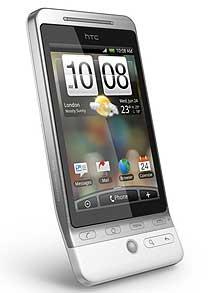 Serenading about its latest mobile handset in its Android line-up, HTC Hero – HTC is claiming that “HTC Hero” is the best Android phone up to now. HTC Hero has been recently announced at London by HTC.
Smart looking smartphone with angled bottom – HTC Hero boasts of its 3.2-inch, 320 x 480, HVGA touchscreen supporting multi-touch and pinch whilst browsing, and 5 megapixel auto-focus camera.
The 14.3mm thick HTC Hero sports a Teflon coating soft-touch finish. The phone comes packed with a slew of features including built-in GPS and a gravity sensor, a digital compass for simple navigation, an accelerometer, a standard 3.5mm headphone jack, anti-fingerprint screen
HTC Hero runs the Google-backed Android operating system. It uses Qualcomm MSM7200A processor running at 528MHz. The phone comes with 512MB ROM and 288MB RAM. The memory of the phone can be expanded to 16GB using a microSD memory card. The phone offers support for 900/2100MHz HSPA and quadband GSM, and 802.11b/g Wi-Fi.
HTC Hero is known for its better browsing capabilities. The handset allows its users to send emails and messages to their friends, and access the services, such as Twitter, Facebook, and Flickr. HTC Hero will be available on T-Mobile and Orange in United Kingdom, in July. HTC has not revealed the price and launch date of HTC Hero yet.
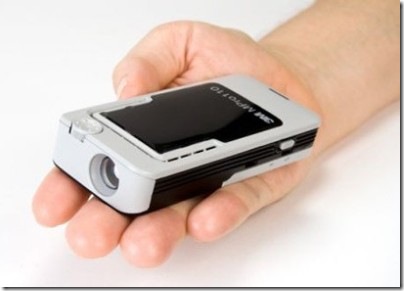 Washington, June 25 : Those who love watching their favourite football teams in action on the big TV screen can now enjoy the same experience even when they are out on the beach—all thanks to mini beamer in cell phones.
Cellphone TV is coming closer as the mini beamer would make it possible to create a public viewing event on a small scale – for example on a white bathing towel by the side of a lake.
Developed by research scientists at the Fraunhofer Institute for Applied Optics and Precision Engineering IOF in Jena in cooperation with their partners in the EU project HYPOLED, the mini projector does not need an additional illumination system like conventional beamers.
As the beamer can operate without an extra light source it offers a number of advantages—firstly, it takes up little space.
The prototype is 2.5 centimeters long, has a diameter of 1.8 centimeters and can be easily integrated in a cellphone or a PDA.
Secondly, the device needs very little energy and therefore does not overtax the battery.
"The key component of the projector is an organic display, or OLED, developed by our colleagues at the Fraunhofer Institute for Photonic Microsystems IPMS in Dresden," said Dr. Stefan Riehemann, group manager at the IOF.
Currently the OLED display produces a monochrome image with a brightness of 10,000 candelas per square meter and for colour images the brightness is about half that level.
The researchers are exhibiting a monochrome prototype at the Laser World of Photonics trade show from June 15 to 18 in Munich. (ANI)
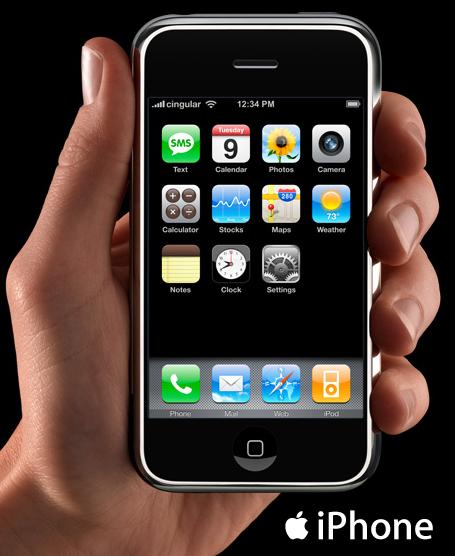 London, June 25 : Scientists have created a revolutionary iPhone feature that makes it possible to run a bath before getting home.
The Bath-o-matic software means the phone can send orders to a set of high-tech taps on a bath tub that can control the temperature, pressure and draining of the water, reports The Telegraph.
The software for iPhone is available free from Apple''s popular App Store. However, users will have to pay 4,000 pounds for the technology at home.
They will then be able to select the temperature, depth and fragrance of the water and even how many bubbles in the bath.
Unique Automation, the company behind the device, recently showed off its wares at a trade show.
A spokesman said: "At the touch of a button, Bath-o-matic fills the bath to perfection - even adding bubbles and perfumes.
"Bringing full automation to the bathroom at last, this technological breakthrough offers energy and water savings plus flooding and scalding prevention." (ANI)
 Specially designed for passionate mobile photography buffs, Nokia’s recently released Nokia N86 is superb convergence of mobile phone and camera.
Nokia N86 comes with its 8 megapixel camera featuring 28 mm Carl Zeiss Tessar lens with triband 3G HSDPA/HSUPA. With the powerful camera, you can capture ace quality photographs in all light conditions. You can enjoy watching videos and photographs through the phone’s 2.6-inch OLED display with 240 x 320 QVGA resolution.
Nokia N86 offers you ample of space for storing your images, videos, and music files. With 8 GB of internal memory, the phone can store up to 4,000 images. You can expand the memory of the phone to 16 GB using microSD card. Through N86, you can share your location with personal content –geotagged photos and videos – on web.
Nokia N86 also offers you several entertainment features including audio/video player, FM radio, and pre-loaded 17 N-Gage games including one chosen by you for free license. With N86, you can enjoy 30-hours of non-stop music. With integrated kick stand, N86 is your ideal gadget for enjoying videos and music. You can enjoy music through the Nokia Bluetooth Stereo Headset BH-214, and you can synchronize your N86 with a PC and TV.
Furthermore, Nokia N86 comes preload with Nokia Maps 3.0 with voice-guided driving directions, Ovi online services suite, a built-in digital compass, along with a trial navigation license for driving, pedestrian navigation, and accelerometer.
Nokia N86 runs S60 3rd Edition. The phone supports FP2, WiFi b/g, and A-GPS. You can buy Nokia N86 for Rs. 27,359.
 The leading manufacturer and distributor of motherboards – Simmtronics has launched Intel G-41 chipset based motherboards for desktop as well as notebook computers, in India.
Qualified for Windows Vista operating system, the motherboards based on Intel G-41 chipset come with Core 2 Duo processor, USB 2.0 and 10/100 LAN. The core Duo processor is power efficient processor running up to 1333MHz front-side bus and consuming lesser power against the Intel chips launched earlier.
The motherboards include Atheros AR8112 10/100 Mbps LAN and for that users are not required to purchase an extra LAN card. The USB 2.0 connectivity allows data transferring at the rate of maximum 480Mb/s.
Supporting SATA HDD, CD-ROM and other advanced devices, along with NCQ function support, the G41T-M motherboards come with integrated SATA II offering a running speed of up to 3.0Gb/s
The G41T-M motherboards come equipped with Intel Graphics Media Accelerator X4500, LGA775 socket for latest Intel Core 2 Quad /Core 2 Duo / Pentium Dual-core /Celeron processors, dual-channel DDR2 memory architecture, and two 240-pin DDR2 DIMM socket with maximum 8 GB support. The motherboards also support DDR2 667/800 MHz memory.
The G41T-M motherboards come with rear panel featuring PS/2 keyboard & PS/2 mouse connectors, four USB ports, VGA port, COM port, RJ45 LAN connector and audio port. Additionally, internal I/O connectors and headers include of 24-pin ATX Power Supply Connector, 4-pin 12V Connector, four Serial ATA connectors, LPT header, Clear CMOS header, etc.
The G41T-M motherboards also feature come with Micro-ATX Size, 244mm x 204mm form factor along with AMI BIOS, with 8Mb SPI ROM supports plug and play 1.0A, APM 1.2, Multi Boot, DMI and ACPI revision 1.0 specification.
The Simmtronics G41T-M motherboards for notebook and desktop computers are available for Rs. 4,200 through Simmtronics Semiconductors in India.
BT announced it will soon launch a virtual data center service aimed at aiding large businesses and government agencies with low-cost, cloud-based enterprise class services. BT plans to roll out the service across data centers in Europe, beginning with the UK at the end of July and other countries in the months following, reports ZDNet.
According to BT, its customers will be able to access the services via an online portal and will have the ability to change their infrastructure in real time throughout the duration of their contract, says vnunet.
Apple has issued an advisory regarding security enhancements included in the iPhone OS 3.0 release 17-06-2009 Wednesday.
 (Credit: Apple)
Here is a synopsis of the 46 iPhone security vulnerabilities addressed by the latest operating-system update for the iPhone and iPod Touch. As may be expected, many of these security patches focus on the Web-browsing framework WebKit.
CoreGraphics Changes to CoreGraphics prevent maliciously crafted image and PDF files from causing unexpected application termination or arbitrary code execution; vulnerabilities causing the same problems in FreeType v2.3.8 were also patched.
Exchange Changes were made to prevent a user from connecting to a malicious Exchange server that could lead to the disclosure of sensitive information by adding improvements to the handling of untrusted certificate exceptions.
ImageIO Changes to ImageIO prevent the use of maliciously crafted PNG images from causing unexpected application termination or arbitrary code execution.
International Components for Unicode Changes to Unicode prevent the use of maliciously crafted content that may bypass Web site filters and result in cross-site scripting.
IPSec Changes to IPSec patch multiple vulnerabilities in the racoon daemon that may lead to a denial-of-service attack.
Libxml Changes to XML library Libxml patch multiple vulnerabilities in Libxml2 version 2.6.16.
Mail Changes were made to the Mail app to give users control over the loading of remote images in HTML messages (see below). Additionally, the app was changed to prevent an application from causing an alert to appear that may be used to initiate a phone call without user interaction.

MPEG-4 Video Codec Changes to the MPEG-4 Video Codec will prevent the viewing of maliciously crafted MPEG-4 video files that may lead to an unexpected device reset.
Profiles Changes to Profiles will prohibit the installation of a configuration profile that may weaken the passcode policy defined by Exchange ActiveSync.
Safari Changes to Safari support the clearing of Safari's history via the Settings application, allowing prevention of disclosure of the search history to a person with physical access to the device. Now search history is actually removed. Additionally, if a user were to interact with a maliciously crafted Web site, a patch has been put in place to prevent unexpected action on another site such as "clickjacking."
Telephony Changes to Telephony address a problem in which a remote attacker may cause an unexpected device reset.
WebKit Changes to Web-browsing framework WebKit were very numerous in this release, given how popular the iPhone has become for Web use. They included many fixes to prevent arbitrary code or script execution, when visiting maliciously crafted Web sites. Some of these vulnerabilities could lead to app crashes and unexpected device resets, or the disclosure of sensitive information.
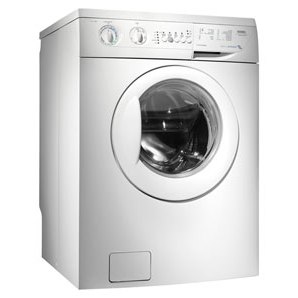 London, June 22 : Water conservation usually takes a backseat while doing laundry, but not anymore, for now a new environmentally friendly washing machine, which uses use only one cup of water and leaves clothes virtually dry, is all set to hit showrooms next year.
Developed at the University of Leeds, the technologyaims save up to 90 per cent of water used by conventional machines, use 30 per cent less energy, and thus can have the environmental impact of taking two million cars off the road.
The washing machine works by replacing most of the water with thousands of tiny, reusable nylon polymer beads, which attract and absorb dirt under humid conditions.
Only a small amount of water and detergent is needed to dampen the clothes, loosen stains and create the water vapour that allows the beads to work.
And after the cycle is finished, the beads fall through a mesh in the machine's drum, and can be re-used up to a hundred times.
The company behind the technology, Xeros, is initially aiming at the commercial washing market, including hotels and dry cleaners.
Bill Westwater, Xeros chief executive, said that growing pressure on companies and consumers to cut water usage and carbon emissions might boost demand for the system.
"We've got an eye on the consumer but it will take time and we hope commercial success could act as a springboard to move into the consumer market," Times Online quoted Westwater as saying.
Stephen Burkinshaw from Leeds developed the technology over the past 30 years. (ANI)
 The “life’s good” company – LG on Thursday declared that it is looking to increase its market share in the flourishing mobile phone market of India. LG announced to launch 50 new mobile handsets by the end of this year in the Indian market.
Announcing its three new smartphones Crystal, GM 730, and Viewty Smart at the telecommunications conference CommunicAsia 2009, LG declared that it is aiming to double its marketshare to 11 percent in the dramatically growing GSM mobile telephony market. Presently, LG has a 5.25 percent market share in GSM segment, and near about 50 percent market share in the CDMA segment.
The Head (Asia Pacific Region), Mobile Communication Company of LG Electronics, Bo H Choi told that LG GM 730 will be released globally in July. He declared that the three touch screen smartphones – Crystal, GM 730, and Viewty Smart – will be released in India by September. He disclosed that the LG GM 730 will be available for over Rs 25,000 in India, but he didn’t reveal the features, and the prices of the other spartphones.
According to Choi, seeing the growing demand of mobile phones in India, LG will focus on India as investment destination. The company is also planning to launch India specific products to attract more and more Indian customers.
Choi disclosed that LG is also planning to hike it the production capacity of its Pune manufacturing plant, which currently produces 5 lakh units of mobile handsets, which are exported to the Middle East, African and Asian markets.
Choi claimed that currently LG is the world’s third largest mobile handset manufacturer behind Nokia and Samsung, but ahead of Motorola and Sony Ericsson. He revealed that LG sold 100.8 million handsets globally to claim about 9 percent market share in the global market in 2008.
 Switching from computers to smartphones, Acer has launched five new feature-rich smartphones, in the price range of Rs. 24,000 to Rs. 35,000, in the Indian market. Celebrated more for its desktops, laptops, and peripherals, Acer certainly is looking to cash the growing popularity of smartphones in India.
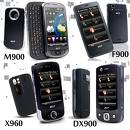
DX900, DX650, X960, F900, and M900 are the five new multimedia smartphones, which have been released by Acer. The DX900 is a dual-SIM handset; the dual-face design, DX650 smartphone features touch screen on one facet and finger-friendly keypad on the other; the F900 and the M900 are being touted for their mobile web browsing capabilities; and the X960 is publicised as an all-purpose smartphone.
Acer has claimed that the smartphones have been designed to satisfy the most sophisticated handheld users, and to make mobile internet experience more interesting.
According to the Acer Senior Corporate Vice-President and President of Acer’s Smart Handheld Business Group, Aymar de Lencquesaing, Acer is planning to launch more phones, with price starting from Rs. 16,000, in order to make significant presence in the flourishing Indian mobile market.
Aymar has told that Acer is currently importing smartphones from Taipai. He also told that the Delhi-based Vision Distribution Pvtd. Ltd. will market and distribute Acer smartphones in the Indian markets. He revealed that Acer has also signed deals with all top retailers, such as Croma and Reliance to retail Acer smartphones.

| Starter | Home Basic | Home Premium | Professional | Enterprise and Ultimate |
| Broad app and device compatibility with up to 3 concurrent applications Ability to join a Home Group Improved taskbar and JumpLists | Starter features plus: Unlimited applications Live Thumbnail Previews & enhanced visual experience Advanced networking support (ad-hoc wireless networks and internet connection sharing) Mobility Center | Home Basic features plus: Aero Glass & advanced windows navigation Easy networking & sharing across all your PCs & devices Improved media format support, enhancements to Windows Media Center and media streaming, including Play To Multi-touch and improved handwriting recognitio | Home Premium features plus: Ability to join a managed network with Domain Join Protect data with advanced network backup and Encrypting File System Print to the right printer at home or work with Location Aware Printing | Professional and Consumer features plus: BitLocker data protection on internal and external drives DirectAccess provides seamless connectivity to your corporate network. (requires Windows Server 2008 R2) Decrease time branch office workers wait to open file across the network with BranchCache. (requires Windows Server 2008 R2) |
Note: Windows 7 Enterprise is available only through Microsoft Volume Licensing
According to Mike Ybarra, general manager for Windows there are some changes to the Windows 7 packaging & marketing in comparison to Windows Vista: "The first change in Windows 7 was to make sure that editions of Windows 7 are a superset of one another. That is to say, as customers upgrade from one version to the next, they keep all features and functionality from the previous edition. As an example, some business customers using Windows Vista Business wanted the Media Center functionality that is in Windows Vista Home Premium but didn't receive it in Business edition. Customers won't have to face that trade-off with Windows 7. With Windows 7 there is a more natural progression from one edition to the next."
"The second change is that we have designed Windows 7 so different editions of Windows 7 can run on a very broad set of hardware, from small-notebook PCs (sometimes referred to as netbooks) to full gaming desktops. This way, customers can enable the scenarios they want across the broad hardware choices they have. "
"The third change lies in how we broadly communicate in the marketplace, to make these choices as simple and clear as possible for customers and partners."
This last point will (according to Microsoft) mean that the company will focus most of their marketing attention to only two primary editions: Windows 7 Home Premium, and Windows 7 Professional. Microsoft thinks that these two editions will serve the majority of their customers' needs. Windows 7 Home Premium as the recommended choice for consumers and Windows 7 Professional the recommended choice for small businesses users.
Microsoft has not yet announced pricing for Windows 7.
Microsoft did a lot of work on the new taskbar for Windows 7. They looked extensively how people were using their computers and started making improvements based on those observations. The number one task for which people use the taskbar is switching between windows. Below I will show and discuss some of the changes/enhancements.
Microsoft has started their taskbar improvements with a facelift that includes larger icons, which make it easier to identify programs, and also makes it easier to target icons with a cursor without accidentally clicking on the icon next to it. The Windows 7 taskbar is 10 pixels (at the default 96 DPI) higher than the taskbar used in Windows Vista, this of course when used as a single row (you are still able to use multiple rows). You'll also note that the taskbar looks more 'glassy'. According to Microsoft the feedback they got was that users dislike Vista's UI where the taskbar would turn opaque and dark.

You can still pin programs to the taskbar by dragging them or via a context menu, just like you have always done with Quick Launch.
In Windows 7 Microsoft effectively combined the QuickLaunch and taskband. In order to maximize the use of available space, Microsoft standardized launching and switching behavior so that only a single representation is made on the taskbar.

As you can see from the images above, the shortcut for Microsoft Word (subtly) changes to represent an opened Word document. Now you may wonder what would happen when you have two or more documents open, and how you would be able to switch between them.
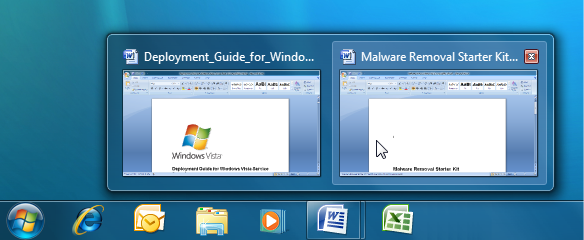
Here is where another improvement to the taskbar comes to light. When hovering over a taskbar button you'll see a thumbnail as you would in Vista. The difference with Vista is that in Windows 7 the thumbnails are now an extension of their corresponding button so you can click on these to switch to a given window. The thumbnails are also a more accurate representation of a window; complete with an application icon in the top left corner, window text and even the ubiquitous close button in the top right.

There is a visual cue of stacked tiles to give a clue whether there are multiple windows running for a program (see picture above).
Another advantage of the single representation is that you can now move taskbar buttons. Quick Launch has always allowed this, but combining this mechanism with the taskband naturally extended rearrange functionality to running windows.
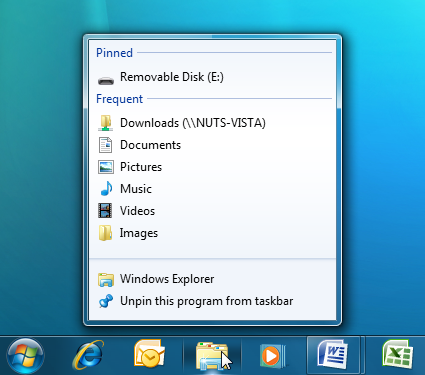
The next improvement I want to talk about is called "Jump Lists". Most users are used to the concept of the context menu that is available for running programs. This menu is accessible by right-clicking on a taskband button. The advantage is that you don't have to start the program to quickly access a task or launch a file.
Above you see the jump list of Windows Explorer's taskbar shortcut, which includes frequently accessed locations as well as the most recent accessed locations. You can also pin specific locations to this list, so you can always access them quickly (Figure).
Notification Area
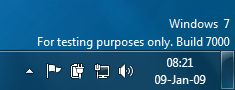 Microsoft also greatly improved the notification area, putting users back in control. By default, only a select few system icons are shown while all others appear in a menu (Figure). Simply drag icons on or off the taskbar to control the experience. Also, every balloon tip that appears in the notification area has a little wrench icon that allows one to quickly configure the icon & notifications (Figure).
Another commonly requested change is that the default taskbar now shows both the time and date.
I think that these are all good improvements to the taskbar, and while it will take a bit of time to get used to the change, the important thing is that these changes definitely improve the functionality of the taskbar.
| The purpose of this FAQ is to provide you with some general information about Windows 7. Q: Windows 7? Q: When will Windows 7 ship? Q: What features will be included in Windows 7? User Account Control improvements. Windows Vista's most hated feature is being completely overhauled to be more customizable. Four settings will be available (Figure):
Updated Windows Explorer. Windows Explorer (Figure) is being updated with a number of new features, including a new toolbar, and a new icon view style called Content (Figure). The search box has also been updated, and is now resizable (Figure). Extended ReadyBoost. First introduced in Vista, ReadyBoost in Windows 7 adds support for concurrently using multiple lash devices (such as USB keys, Secure Digital cards, and internal flash devices) and for caches larger than 4 GB. Improved "Out Of Box" experience. Microsoft made several improvements to Windows 7 so a user's first experience when running the OS for the first time will be improved. Windows 7 expands on Vista's setup routine; for example when installing Windows 7 on a PC that includes a Wireless Network, setup will prompt you to join a network during the setup phase. Multi-touch. Windows 7 will include integrated support for multi-touch displays and support the "Surface" multi-touch technologies. HomeGroup networking. Windows 7 HomeGroup makes it easier to create a home network where PCs share pictures, music, videos, documents, printers, and other resources with each other. Computers running Windows 7 automatically identify and connect with each other (Figure). Location Aware Printing. When you change network locations, such as when taking your work laptop home for the evening, the default printer setting can change to relect the best printer for that new location. When you print at work, Windows 7 will print to your work printer. When you print at home, Windows 7 will automatically select and use your home printer. ClearType Text Tuner. A ClearType Text Tuner can be found in the Windows 7 Control Panel. In the past, Microsoft Powertoys provided access to a ClearType Tuner which has now been integrated into Windows 7. This will let users configure their display to their personal liking (Figure). Sidebar Removed. Microsoft removed Windows Sidebar from Windows 7, but the Windows Gadgets infrastructure remains. In Windows 7, Gadgets can only be viewed on the desktop. As such, the Gadget Gallery found in the Windows Sidebar on Vista is now available from the desktop right-click menu. Windows Solution Center. Microsoft replaced Windows Security Center with a new utility called Windows Solution Center. Besides monitoring Firewall, Automatic Updating, Virus and Malware protection, Internet security settings and User Account Control settings, the new Solution Center will also monitor PC maintenance and performance, backup, troubleshooting, Network Access Protection (NAP), and much more (Figure). Microsoft Paint. Windows 7 includes a dramatically improved version of Microsoft Paint (finally!), the first major upgrade to this software since it first appeared in Windows (Figure). This includes the Scenic Ribbon to replace the old menu's, similar to the ribbon in Microsoft Ofice 2007. Controls in Paint are touch-ready, so you can even use your finger to paint and choose colors or shapes (when you have a touch screen). Internet Explorer 8. Windows 7 will include the latest version of Microsoft's Web browser. Windows Media Center. Windows 7 will include a new version of Windows Media Center. Microsoft WordPad. Word Pad also takes advantage of the Scenic Ribbon. Other improvements to WordPad include highlighting, line breaks, additional text colors, bullets, indents, print preview enhancements, picture insertion, and zoom, making WordPad a capable word processor (Figure). Calculator. Calculator has a new look and some brand-new features. You'll find calculation history, unit conversion (Figure), calculation templates, date calculations, and controls that are optimized for touch. Sticky Notes. Sticky Notes support ink and text input. You can paste text into Sticky Notes, resize them on the desktop, and use note colors to personalize or organize Sticky Notes. Q: What are the System Requirements to run Windows 7? Q: Will Windows 7 be a 32-bit or 64-bit operating system? | Some of the new wallpapers:            |


